|
Ask any number of Boomers
around Huntington Beach about the 1960s, and they’ll probably give you
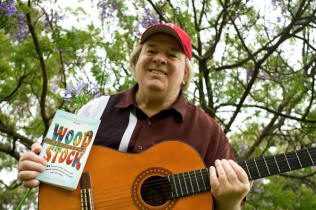
plenty of recollections. But among local historians, Dixon Hearne is a
standout. The 61-year-old, who formerly taught at Chapman University and
has published both fiction and nonfiction, recently contributed the
final chapter to the book “Woodstock Revisited: 50 Far Out, Groovy,
Peace-Loving, Flashback-Inducing Stories From Those Who Were There.”
Hearne, a Huntington Beach resident since 1978,
didn’t actually attend the legendary rock festival, but the publisher
asked him to cap the collection with an essay about how the Woodstock
generation transformed American culture. Shortly after the book’s
release, Hearne spoke to the Independent about how the world has changed
in the last 40 years — and how it hasn’t.
This book commemorates the
40th anniversary of Woodstock, and a lot of people reading it are
probably going to be young people who weren’t around at the time. Is
there anything about the ’60s that’s hard to explain to someone who
wasn’t there?
There was general feeling
among youth that the world was on the brink of a new age and we were the
catalysts, the heralds. It spread quickly and cut deep into the American
psyche — indeed, the world’s. America had never experienced such a
threat to its core values and lifestyle — and taking root in every
corner of the nation. Post-Boomers have a difficult time in their
struggle for some cultural legitimacy in the wake of their grandparents
and parents, who were the original counterculture prototype.
You say there was a general feeling at the time
that your generation was going to change the world. In hindsight,
looking back 40 years later, was that feeling accurate?
Post-Woodstock, we found ourselves thrust upon a
world that still did not understand us or our struggle to be differently
alike, an adult world where survival of the fittest was skewed heavily
toward the opposing team. The Woodstock generation went kicking and
screaming, but we survived, even thrived, and lived to realize the
glorious fruits of the last children’s crusade. Girls, we now know, can
study and learn just as well in pants, long hair is not a predictor of
success (or lack thereof), rock ’n’ roll has never been unquestionably
linked to cancer, and the nation’s churches have not closed up shop.
Did you consider yourself a hippie back then?
Where I went to college, we were basically
weekend hippies and hippies a la carte. Drugs were popular, even with
fraternities and sororities. I teetered on the edge of dropping out and
becoming a street urchin in ’Frisco till I realized this meant no car,
no food, no privacy and poor hygiene. We all dressed and talked the part
— right down to our jeans and sandals and ponchos and our toked,
pie-eyed conversations. And, of course, we all wanted to be on the cover
of Rolling Stone.
Given how few hippies there are nowadays, it
seems like most other people valued privacy and hygiene, too.
Yes. Few do communes anymore, or crash on pallets
10 abreast or in cramped Volkswagens or city parks. We do not down a
fifth of Jack Daniels or chug a pitcher of Bud in 60 seconds, or
otherwise drink ourselves under a table on a dare or fry what’s left of
our brains with recreational drugs. Nor do most picket or protest in
freezing rains or sweltering heat — we’ve passed the torch, the signs,
the banners and the microphones to our kids. We’ve learned to fit in, to
find our place in the bigger picture.
When Barack Obama was elected last year, some
people said the excitement surrounding his victory had an echo of the
1960s. Do you agree, or will we never see anything like the ’60s again?
It’s an awkward comparison indeed. While the
Woodstock generation represented a departure from the status quo
sociopolitical picture of the day, Barack Obama seems to rise more on a
platform of political expediency. The election seems to reflect an angst
to distance ourselves from President Bush — total and absolute change,
and the more different the better. It’s too soon to know if anything
from his tenure will make its way into the very fabric of everyday
American life. Today, we see strong and tangible evidence of the
Woodstock generation’s presence everywhere.
Give me an example of where we can see it.
In our dress, we’ve become a nation of primarily
“casual” dressers — even corporate offices have casual Fridays. Check
our nurses and public workers. In our laws, ACLU watchdogs and Boomer
types are still on the beat to assure equal pay, equal rights,
desegregation and human rights. In our social mores, public celebration
of the human body burst out of the closet with the Woodstock generation.
Witness the acceptance and extent of public nudity today — TV, movies,
rock concerts, art, etc. Prior to the late ’60s, Americans had to hanker
after stars fully clothed on their TV sets or magazines with brown
wrappers.
What do you think kids of the Woodstock
generation would have thought of today’s Huntington Beach?
Cool, dude! You can just, like, hang out every
day after graduation and still live at home? Surf’s up! What happened to
the Golden Bear? Who’s rockin’ at House of Blues tonight? Can I really
roll one right here on the street?
Of course, that was before they wised up and
became lecturers at Chapman.
Most, I’m sure, chased their ambitions to their
logical ends. I wanted to teach. I spent years watching our culture
change before my very eyes in classrooms, elementary through college. I
noted that students never really expressed a challenge to the day’s
dress or language or music — fewer rallying points of contention after
the Woodstock generation moved the bars.
How To Get It
“Woodstock Revisited: 50 Far Out, Groovy,
Peace-Loving, Flashback-Inducing Stories From Those Who Were There” came
out this month from Adams Media. To learn more about the book, visit
www.literarycottage.com/woodstock.html
|